
Quick Answer: grow cucumbers hydroponically
grow cucumbers hydroponically by giving them a fruiting-ready system (Dutch bucket, drip, or media bed), strong daily light, a complete nutrient solution at fruiting strength, stable pH in a soilless band near 5.0–6.0, warm roots with good oxygen, a vertical trellis, and either natural or hand pollination for fruit set. Cucumbers are vigorous vines: plan space, support, and reservoir capacity before you plant. Start from clean transplants, keep EC moderate rather than “maxed out,” and harvest fruits regularly so plants keep producing.
For fruiting crop context, see hydroponic tomatoes and hydroponic peppers. Manage solution chemistry with the pH guide and nutrients guide.
Key Takeaways
- University of Florida’s greenhouse cucumber handbook (CV268) treats cucumbers as a serious greenhouse fruiting crop: support, irrigation discipline, and nutrient management matter more than “set and forget.”
- UF Gardening Solutions describes cucumbers as warm-season vines that need support and consistent moisture—translate that indoors to trellis + reliable fertigation.
- Oklahoma State’s soilless hydroponic guidance keeps solution pH roughly 5.0–6.0 for nutrient availability.
- Dutch bucket / drip / media systems usually fit cucumbers better than tiny NFT channels designed for lettuce.
- Pollination is required for many cultivars; parthenocarpic greenhouse types can fruit without pollination—read the seed packet.
- Bitter fruit is often stress-related (irregular watering, heat, nutrient extremes), not a mystery “bad seed” alone.
- Compare system options in DWC vs NFT vs Dutch bucket and Dutch bucket basics.
Related HydroponicEra guides
- Best plants for hydroponics
- Dutch bucket hydroponics for beginners
- Best grow lights for hydroponics
- How often to change hydroponic water
- PPFD and DLI light levels for hydroponic plants (draft sibling)

Why you grow cucumbers hydroponically in fruiting systems
Cucumbers (Cucumis sativus) produce long vines and heavy fruit loads. Hydroponics can deliver water and minerals continuously, which matches a fast-growing vine—if roots stay oxygenated and the canopy gets enough photosynthetic light.
UF/IFAS greenhouse cucumber production materials emphasize greenhouse cultural systems (media, irrigation, environment) rather than a tiny hobby raft. Home growers can still succeed in a garage or tent, but the hardware should resemble a fruiting system: sturdy net pots or buckets, media that drains, a reservoir that will not empty overnight, and a trellis that can hold fruit weight.
Penn State’s cucumber production overview and University of Maryland Extension’s home-garden cucumber guidance both stress warmth, support, and consistent moisture. Hydroponics replaces soil moisture management with fertigation timing—but the plant still wants warm air, strong light, and uninterrupted water supply.
Choose a System for Hydroponic Cucumbers

| System | Beginner fit | Watch-outs |
|---|---|---|
| Dutch bucket / Bato | Excellent for 1–4 vines | More plumbing; check emitters |
| Drip into coco / perlite / rockwool | Excellent | Avoid chronic waterlogging |
| Large DWC tub | Possible for compact types | Root mass + oxygen demand rise fast |
| NFT lettuce channel | Usually poor fit | Clogs, vine weight, root crowding |
| Tower / pocket | Only compact cultivars | Fruit weight and light inside canopy |
UF’s production-systems chapter for greenhouse vegetables (CV263) frames media and hydroponic layouts as crop-dependent choices. If you are still shopping hardware, start with the system beginner guide and Dutch bucket article.
Step-by-step: grow cucumbers hydroponically
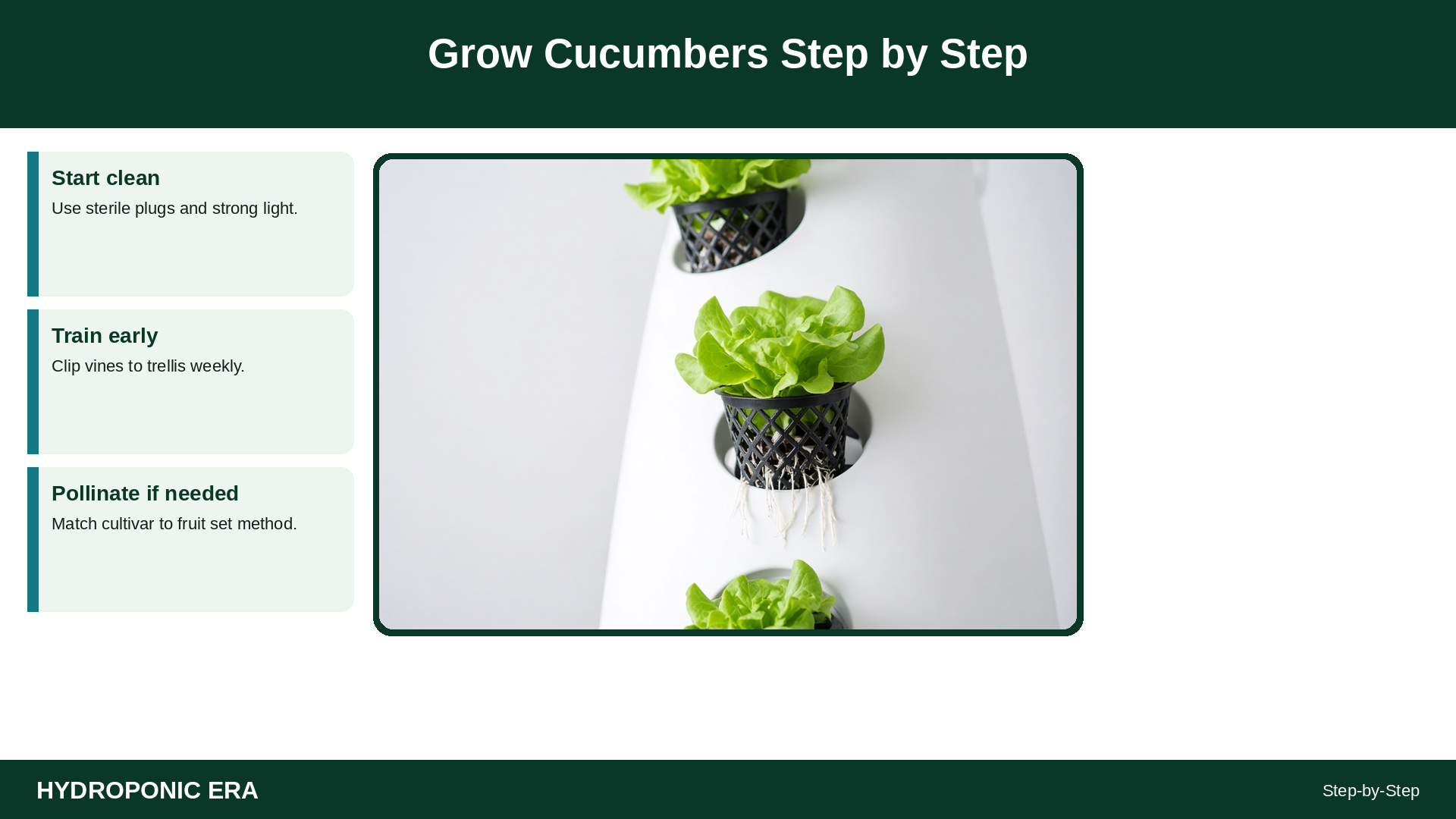
- Pick the right cultivar. Greenhouse / parthenocarpic types reduce pollination hassle. Bush types need less horizontal space. Avoid giant field slicers in a tiny tent.
- Start seeds in clean inert plugs (rockwool or similar). Keep moist and warm until sprouts appear, then give strong light immediately to prevent stretch.
- Transplant when roots show and true leaves are present. Support the stem; do not bury the crown in stagnant water.
- Install trellis early. Twine, clips, or a vertical net—cucumbers climb better if you train them before vines flop.
- Mix a complete hydroponic nutrient at a mild vegetative strength first, then increase toward fruiting strength as flowers appear. Follow the label; do not stack random boosters on day one.
- Set pH after EC/strength into a soilless availability band near 5–6 (OSU hydroponic guidance).
- Provide strong light. Virginia Tech’s DLI guide lists cucumber among high-light fruiting crops (roughly 20–30 mol·m⁻²·day⁻¹ recommended DLI range in their crop table). Pair with the grow lights guide and the PPFD/DLI draft.
- Pollinate if needed. For standard monoecious types, move pollen from male to female flowers (female flowers show a tiny fruit behind the bloom). Parthenocarpic types may not need this.
- Prune and train. Remove damaged leaves, keep the main stem organized, and prevent a tangled light-blocking canopy.
- Harvest often. Overgrown fruits signal the plant to slow; pick at the size your cultivar intends.
- Refresh solution on a schedule matched to plant demand—see water-change guidance.
Important Growing Variables
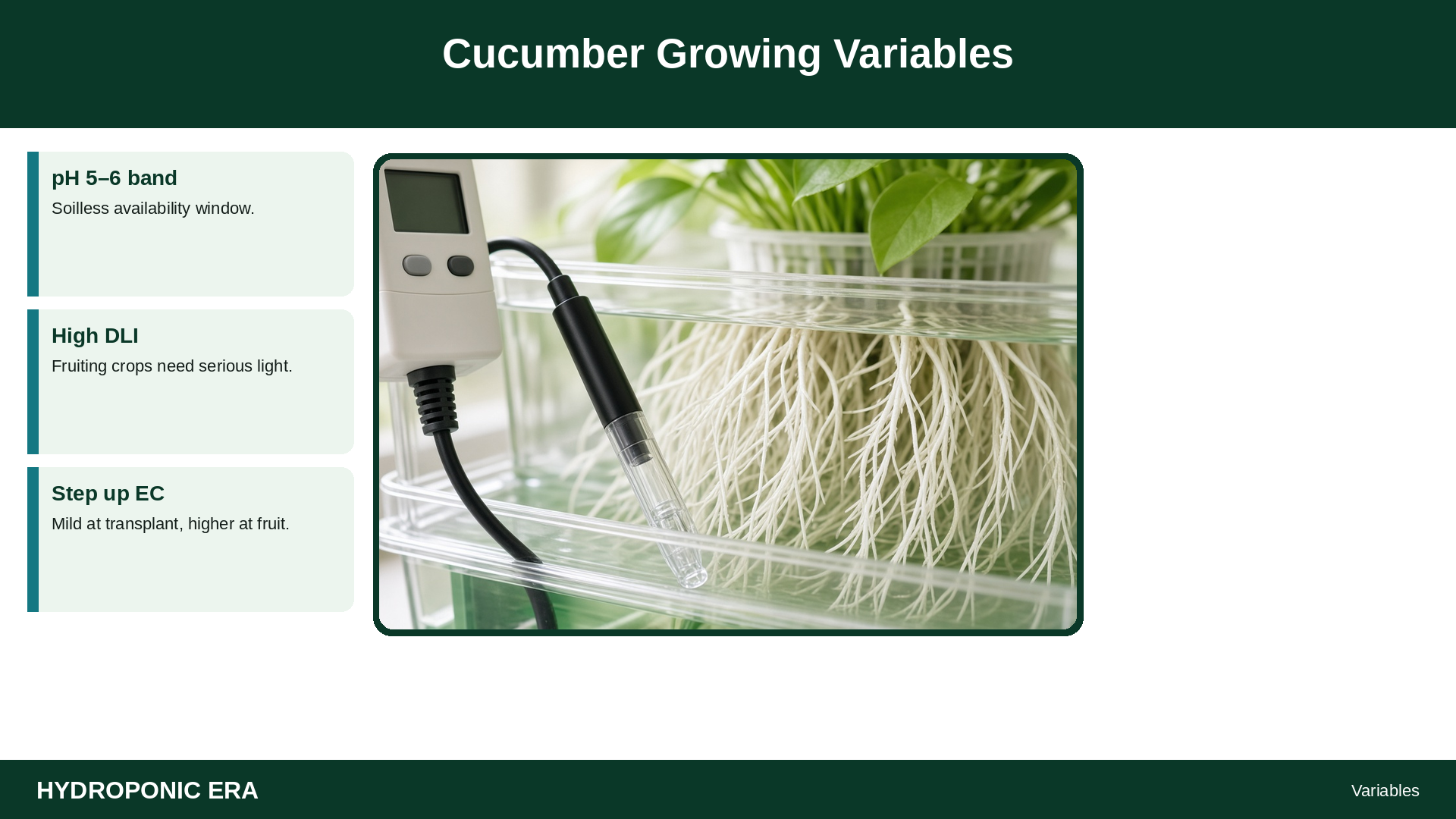
| Variable | Practical beginner guidance | Notes |
|---|---|---|
| Light / DLI | High daily light for fruiting | VT lists cucumber ~20–30 mol·m⁻²·d⁻¹ DLI range |
| pH | ~5.0–6.0 solution band | OSU soilless hydroponic guidance |
| Nutrient strength | Step up from mild veg to fruiting | Watch leaf edges for burn |
| Root oxygen | Strong aeration or free-draining media | See dissolved oxygen draft |
| Temperature | Warm season crop | Cold nights stall growth |
| Support | Trellis before vines sprawl | Fruit weight is real |
| Pollination | Match cultivar type | Hand pollinate if needed |
UF Gardening Solutions notes cucumbers want consistent moisture and support outdoors; indoors, emitter failure or empty reservoirs create the same stress pattern as drought—wilting, flower abortion, and off flavors.
Common Mistakes

- Trying to force large vines through a lettuce-only NFT channel
- Skipping trellis until vines collapse
- Assuming every cucumber fruits without pollination
- Cranking EC too high at transplant, then chasing tip burn
- Letting reservoir temperature soar under lights (see reservoir temperature draft)
- Ignoring algae and slime in clear tanks (see algae draft)
- Harvesting too late, then wondering why plants “stopped”
Troubleshooting Cucumber Problems

| Symptom | Likely causes | What to do |
|---|---|---|
| Flowers but no fruit | Missing pollination / wrong cultivar expectation | Hand pollinate or switch to parthenocarpic types |
| Bitter fruit | Stress: water gaps, heat, nutrient extremes | Stabilize fertigation and environment; harvest younger |
| Yellow new leaves | pH lockout / micronutrient availability | Check pH; review lockout draft |
| Leaf edge burn | High EC / nutrient burn | Measure strength; dilute; see nutrient burn draft |
| Blossom-end scarring / soft tips | Calcium uptake / irregular watering issues | See Ca/Mg draft; stabilize irrigation |
| Wilting with wet media | Low oxygen / root disease pressure | Improve drainage/aeration; check brown roots guide |
| Powdery white leaf spots | Powdery mildew pressure | Improve airflow; remove worst leaves; reduce leaf wetness |
If roots turn brown and smell foul, follow brown roots troubleshooting. Yellowing leaves more broadly: yellow leaves guide.
What to Check in Your Own Cucumber System
- Is the trellis carrying weight safely?
- Are emitters dripping on schedule?
- Is EC rising between reservoir top-offs?
- Are female flowers receiving pollen (if required)?
- Are roots pale and firm, not slimy?
- Is canopy light reaching middle leaves, or only the top?
Suggested Beginner Schedule
| Stage | Focus | Actions |
|---|---|---|
| Seedling | Compact growth | Strong light; mild nutrients after true leaves |
| Vine training | Structure | Trellis; prune chaos; stable pH/EC |
| Flowering | Fruit set | Pollinate if needed; maintain calcium supply and steady irrigation |
| Harvest | Continuous pick | Harvest small/medium frequently; refresh solution |
| Between crops | Hygiene | Clean lines, replace tired air stones, sterilize media if reusing |
Media note: UF discusses perlite and related media approaches for greenhouse tomato/cucumber culture. Whatever you choose—coco, clay pebbles, rockwool, perlite—match irrigation frequency to water-holding capacity. Compare options in growing media for hydroponics (draft sibling).
Nutrient note: Use a complete hydroponic formula. Fruiting crops often need more total strength than lettuce, but “more” is not infinite—leaf tip burn is your early warning. If symptoms look like burn, do not add more calcium products blindly; measure first.
Light note: Cucumbers are not a windowsill herb. If plants stretch, flower sparsely, or produce pale fruit, raise DLI before blaming genetics.
Final Cucumber Success Checklist
- Fruiting-capable system with drainage and support
- High daily light without chronic bleaching
- pH kept in a soilless availability band
- EC stepped up with growth—not spiked overnight
- Pollination plan matched to cultivar
- Frequent harvest of properly sized fruits
- Clean reservoir and oxygenated roots
Measurement and Logging Habits for Fruiting Vines
Cucumbers reward growers who treat the reservoir like a small lab notebook. Each day in a small system, log solution volume, EC, pH, and a one-word root note (firm / pale / dull). Weekly, note flower counts, fruit set, and any leaf-edge burn. These habits catch emitter failures and salt creep before bitterness and abortion become the only feedback.
If EC climbs while volume falls, top up with pH-adjusted water first. If both EC and plant demand stay high for days, plan a full change using the water-change guide. Pair chemistry logs with canopy notes: a vine that suddenly stops setting fruit may be pollination-limited, light-limited, or root-limited—three different fixes.
For light, measure PPFD at the top of the trellis and mid-canopy. Fruiting DLI bands from Virginia Tech are high; a bright top and dark middle often means you need training or a second light bar more than another fertilizer bottle. Keep the PPFD/DLI guide nearby when you change fixture height.
Sanitation between crops matters more for vines that occupy a room for months. Flush lines, wash buckets, and inspect drip stakes. Reused media should be cleaned deliberately—see growing media. If root disease appeared, do not casually reuse the same clay pebbles without a serious wash protocol.
Fruiting checklist: grow cucumbers hydroponically with fewer surprises
Use this checklist when you grow cucumbers hydroponically past the cute seedling stage into real vines.
| Area | Ready looks like | If not ready |
|---|---|---|
| System | Dutch bucket/media or other fruiting-capable setup with support | Do not force heavy vines into tiny raft holes without a plan |
| Trellis | Vertical string/net installed before vines flop | Install support now; tangled vines reduce airflow |
| Light | Strong daily light suited to fruiting crops | Raise intensity/duration carefully; watch leaf stress |
| Pollination | Plan for bees/hand pollination indoors | See indoor pollination guidance for fruiting plants |
| Solution | Stable pH band; fruiting-appropriate strength; logged EC | Correct chemistry before chasing “more bloom nutes” |
- Prune with a purpose: airflow and light to developing fruit matter more than saving every side shoot.
- Watch for tip burn / blossom-end issues—often calcium uptake and environment, not only “needs Cal-Mag.”
- Harvest on size/quality for your cultivar; oversized fruit can stall plants.
When you grow cucumbers hydroponically beside tomatoes, remember shared pests and humidity habits—scout undersides of leaves weekly.
grow cucumbers hydroponically: practical review sheet
Use this review sheet to keep grow cucumbers hydroponically actionable after you finish the main guide.
- What did you measure today related to grow cucumbers hydroponically?
- What did you change with your hands (not just what you bought)?
- What will you re-check in 24–48 hours about grow cucumbers hydroponically?
- Which linked HydroponicEra guide should you reread next?
- What cleaning or logging step did you skip last cycle?
| Item | Today | Next check |
|---|---|---|
| Environment | ||
| Solution (pH/EC) | ||
| Roots / pests / biofilm | ||
| Plant response |
Print or duplicate this table in your notes app. The goal is not paperwork—it is fewer repeated mistakes around grow cucumbers hydroponically.
When results are unclear, slow down and restate the problem in one sentence that includes grow cucumbers hydroponically, then list the last three changes you made. Most home-system failures come from stacked changes without logs. Keep grow cucumbers hydroponically paired with basic hygiene: clean reservoirs, honest meter calibration, and root inspection. If you cannot explain your last adjustment, do not add another product. Re-read the troubleshooting section and apply one change at a time while you watch how grow cucumbers hydroponically interacts with pH, temperature, and oxygen.
When results are unclear, slow down and restate the problem in one sentence that includes grow cucumbers hydroponically, then list the last three changes you made. Most home-system failures come from stacked changes without logs. Keep grow cucumbers hydroponically paired with basic hygiene: clean reservoirs, honest meter calibration, and root inspection. If you cannot explain your last adjustment, do not add another product. Re-read the troubleshooting section and apply one change at a time while you watch how grow cucumbers hydroponically interacts with pH, temperature, and oxygen.
grow cucumbers hydroponically: habits that compound
These habits keep grow cucumbers hydroponically practical between deep cleans and big changes.
- Keep notes when you work on grow cucumbers hydroponically so small changes stay visible across weeks.
- Revisit grow cucumbers hydroponically after any reservoir reset, media change, or heat wave.
- Teach one other person your grow cucumbers hydroponically checklist—explaining it catches gaps.
- Photograph the system when grow cucumbers hydroponically looks correct; compare when it does not.
grow cucumbers hydroponically FAQs

Can I grow cucumbers in DWC?
Yes for compact plants if aeration is strong and the tub is large enough. Many growers prefer Dutch bucket or drip media for heavy vines.
Do hydroponic cucumbers need bees?
Only if the cultivar requires pollination. Parthenocarpic greenhouse types can set fruit without pollinators; standard garden types often need hand pollination indoors.
Why are my cucumbers bitter?
Stress is a common driver—irregular watering, heat, or nutrient extremes. Stabilize the root zone and harvest younger fruits.
What pH should I use?
Keep the nutrient solution in a soilless hydroponic band near about 5.0–6.0 per Oklahoma State hydroponic guidance, then fine-tune by plant response.
How much light do cucumbers need?
They are high-light fruiting crops. Virginia Tech’s DLI introductory guide lists cucumber in a high recommended DLI range (about 20–30 mol·m⁻²·day⁻¹). Measure PPFD and calculate DLI rather than guessing from bulb wattage.
Sources
- University of Florida IFAS — CV268: Greenhouse Cucumber Production
- University of Florida IFAS — CV263: Production Systems (Greenhouse Vegetable Handbook)
- University of Florida — Gardening Solutions: Cucumbers
- Penn State Extension — Cucumber Production
- University of Maryland Extension — Growing Cucumbers in a Home Garden
- Oklahoma State University Extension — Hydroponics
- Oklahoma State University Extension — Electrical Conductivity and pH Guide for Hydroponics
- Virginia Cooperative Extension — SPES-720: Calculating and Using Daily Light Integral (DLI)
- University of Florida IFAS — HS405: Hydroponic Vegetable Production in Florida
3 thoughts on “How to Grow Cucumbers Hydroponically: Beginner Guide”