
Quick Answer
How to grow cauliflower hydroponically: treat cauliflower as a cool-season heading brassica that is pickier than kale: strong light, cool temperatures, steady calcium and complete nutrition, and careful timing. Media drip/Dutch preferred for curd development; blanch or choose self-blanching types if whiteness matters.
Use HydroponicEra cluster links for pH, nutrients, lights, system choice, EC/TDS, and seedlings so this crop page stays practical rather than isolated.
Key Takeaways
- Maryland Extension cauliflower culture: cool, careful growth for quality curds—hydroponics does not cancel heat stress.
- Prefer media systems that support larger plants through a long heading period.
- Steady growth beats aggressive EC spikes during curd formation.
- Match cauliflower to a system that fits its root and climate habits—do not copy a lettuce recipe blindly.
- Oklahoma State soilless hydroponic guidance typically places solution pH near a plant-available band around 5.5–6.5 (verify with a calibrated meter).
- Use a complete hydroponic nutrient at a strength matched to crop stage—start milder for transplants than fruiting-crop bottles suggest.
- Strong, measured light matters as much as fertilizer—see PPFD/DLI thinking and the grow-lights guide.
- Root oxygen and reservoir hygiene prevent many mystery failures (dissolved oxygen, brown roots, cleaning guides).
- When leaves yellow, check pH and EC before assuming a single element is missing (lockout + yellow-leaves guides).
- Harvest style should match cauliflower biology—do not strip plants beyond recovery.
Related HydroponicEra guides
- Broccoli
- Ca/Mg
- Tip burn
- Reservoir temperature
- Humidity
- Best plants for hydroponics
- DWC vs NFT vs Dutch bucket
- Growing media
- Grow lights

Why Cauliflower Belongs in a Hydroponic Plan
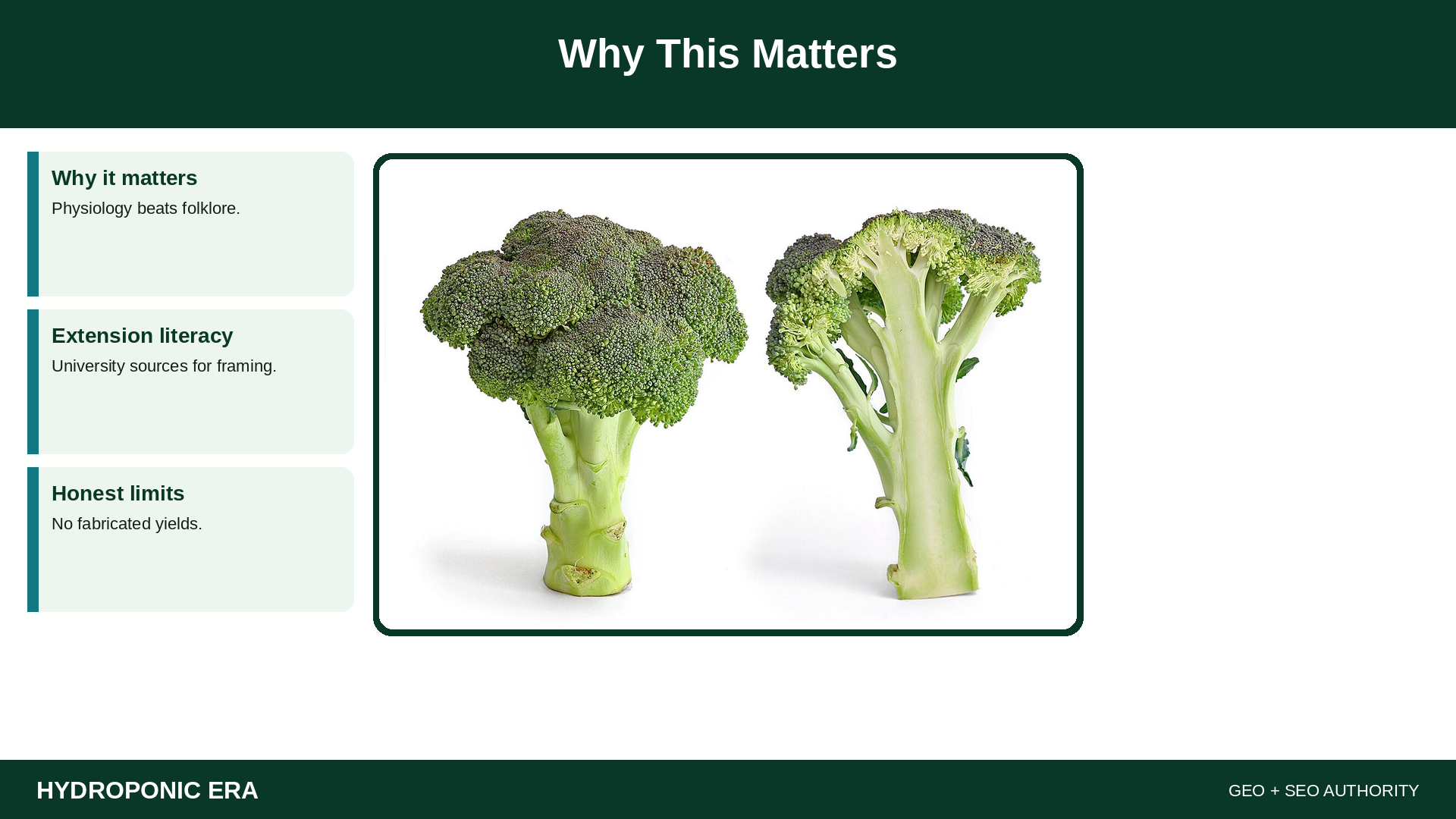
University of Maryland Extension’s cauliflower resource and related brassica extension pages describe cool conditions and careful culture for quality curds. Hydroponics can deliver water and nutrients precisely, but heat stress still causes buttoning or poor curds.
Compare broccoli and cabbage. Cauliflower often needs cooler nights and more patience than leafy greens in lettuce or spinach guides.
Curd disorders are often climate and calcium-transport stories more than “missing magic bottles.” Use tip burn, Ca/Mg, humidity, and reservoir temperature together.
Cauliflower (Brassica oleracea (Botrytis group)) still follows measurable plant physiology: light, root oxygen, solution chemistry, and harvest timing. Extension crop pages describe outdoor habits; hydroponics changes delivery of water and minerals, not the need for those fundamentals. Pair this page with best plants, starting at home, and beginner mistakes so expectations stay honest.
Choose a System for Hydroponic Cauliflower
| System | Fit for Cauliflower | Watch-outs |
|---|---|---|
| Dutch / drip | Best | Support + irrigation control |
| Ebb and flow | Good | Avoid extremes |
| DWC | Possible | Oxygen + cool solution |
| NFT | Challenging for large plants | Channel limits |
| Kratky | Poor for full curds | Not sized for long crop |
Compare hardware in DWC vs NFT vs Dutch, DWC, NFT, Dutch bucket, and ebb and flow.
Step-by-Step: Cauliflower in Hydroponics
- Start clean: fresh seed or disease-free starts and sterile plugs (germination methods).
- Germinate with even moisture and early light so seedlings do not stretch (seedlings guide).
- Transplant when roots hold the plug into net pots with appropriate media (net pots, media).
- Choose the system from the table above rather than forcing every crop into one jar.
- Mix a complete nutrient and measure EC/TDS (mixing guide, EC/TDS); set pH after strength.
- Provide crop-appropriate light using lights and PPFD/DLI guides.
- Maintain aeration, temperature, and hygiene (dissolved oxygen, air pumps, cleaning).
- Harvest with the crop’s biology in mind—do not strip plants beyond recovery.
- Reset solution when EC drifts oddly, roots smell, or you change crops (when to flush, water changes).
- Keep notes on light, EC, pH, and symptoms so you learn your room.
- Keep roots cool if room air runs warm—heat stresses curd quality.
Important Growing Variables

| Variable | Practical guidance | Notes |
|---|---|---|
| Light | Match crop class (leafy vs fruiting vs rhizome) | PPFD/DLI, lights, photoperiod |
| pH | ~5.5–6.5 soilless band (OSU framing) | pH, fix pH, meters |
| Nutrient strength | Start mild; raise with growth | EC/TDS, burn |
| Oxygen / flow | Never ignore roots | DO, air pumps |
| Temperature | Crop-specific comfort | reservoir temperature |
| Hygiene | Opaque reservoirs; scheduled changes | algae, cleaning, reservoir setup |
| Curd quality | Cool + steady growth | Heat causes buttoning/poor curds |
Penn State’s hydroponic nutrition principles remind growers that essential elements have functions—and that deficiency symptoms can be confused with lockout. Measure before you stack additives. If pale leaves appear, use yellow leaves, deficiency chart, and lockout together.
Harvest, Quality, and Ongoing Care for Cauliflower

Harvest curds when they reach the size and density expected for the cultivar, before they become ricey or discolored. Handle gently; bruised curds store poorly.
If curds brown or button, fix climate first. Fertilizer stacking rarely repairs heat-driven disorders. Log temperatures alongside EC so you learn which variable actually moved the result.
After harvest, maintain reservoir hygiene and watch for pests on soft new growth (pests, cleaning). If growth stalls, read slow growth and wilting before dumping random additives.
Common Mistakes
- Copying a lettuce feed/light recipe without adjusting for cauliflower
- Hot nutrient strength on seedlings
- Ignoring pH drift until leaves look deficient
- Weak light blamed on bad nutrients
- Skipping root checks when plants wilt
- Overcrowding net pots or channels
- Clear reservoirs growing algae under LEDs
- Changing five variables overnight when cauliflower only needed one fix
- Forcing cauliflower in a hot tent
- Huge EC swings during heading
- Harvesting too early from impatience
- Ignoring wrapper-leaf tip burn
Troubleshooting Cauliflower Problems

| Symptom | Likely causes | What to do |
|---|---|---|
| Buttoning / tiny curds | Heat / stress / crowding | Cool environment; reduce stress |
| Brown curd | Tip burn-like / RH / Ca issues | Airflow; moderate EC; Ca availability |
| Yellow leaves | N / EC / roots | Measure; inspect roots |
| No curd | Wrong stage / heat / light | Patience; cool; verify cultivar days |
| Soft rot after harvest delay | Hygiene / humidity | Harvest on time; clean tools |
Also see wilting, slow growth, yellow leaves, brown roots, and nutrient lockout when symptoms overlap.
What to Check Before You Change Nutrients
- Calibrated pH and EC readings today?
- Root color and smell normal?
- Light intensity/distance appropriate for this crop?
- Reservoir temperature in a safe band for oxygen?
- Harvest pressure vs plant recovery balanced?
- Irrigation leaving air in media (if media-based)?
- Any pests on leaf undersides or sticky residue?
- Did you change only one major variable since last check?
FAQs

Is cauliflower harder than broccoli hydroponically?
Often yes—curd quality is sensitive to heat and stress.
Indoor tents OK?
Only if you can keep temperatures in a cool brassica range.
Self-blanching cultivars?
Helpful for white curds without tying leaves.
Shared with cabbage?
Possible if cool and EC suit both.
How long?
Longer than lettuce—check cultivar days to maturity and do not invent fake yields.
Nutrients?
Complete feed; measure; watch tip burn on wrapper leaves.
Sources
- University of Maryland Extension — Cauliflower
- University of Minnesota Extension — Growing cabbage
- University of Florida IFAS — HS1279: Leafy Greens in Hydroponics and Protected Culture for Florida
- Oklahoma State University Extension — Electrical Conductivity and pH Guide for Hydroponics
- Oklahoma State University Extension — Hydroponics
- Penn State Extension — Hydroponics Systems and Principles of Plant Nutrition
- Virginia Cooperative Extension — SPES-720: Calculating and Using Daily Light Integral (DLI)
- Ohio State University Extension — HYG-1611 Cabbage