
Introduction
If your plants look hungry even though you are feeding them, you need to learn how to control pH in hydroponics. There is no soil to buffer the root zone, so the solution you mix is the environment the roots live in.
This guide keeps the process simple: measure, mix nutrients, then adjust slowly.
What Is pH, and Why Does It Matter in Hydroponics?

pH is a 0 to 14 scale of how acidic or basic a solution is. 7 is neutral. Below 7 is acidic. Above 7 is basic.
The scale is logarithmic, so a one-point change is a tenfold change in acidity. Moving from 6.5 to 5.5 is a much bigger shift than it looks on a meter.
In hydroponics, pH decides whether nutrients stay dissolved and available. University of Missouri Extension notes that water pH affects nutrient solubility. If the reading is too far off, plants cannot take up what they need, or some nutrients become too available.
The fertilizer is still in the tank. The roots just cannot use it well. That is nutrient lockout.
Soil has a natural buffer. A reservoir does not. Oklahoma State University explains that hydroponic growers have to manage pH on purpose, because nothing else holds the root environment steady.
If you are still setting up your first system, start with our hydroponic garden beginner’s guide.
What Is the Ideal Hydroponic pH Range?

There is no single magic number. For most crops, the practical target is 5.5 to 6.5 when you control pH in hydroponics at home.
Missouri Extension and many nutrient labels use that band. Oklahoma State is a little tighter on the solution itself: about 5.0 to 6.0, usually around 5.5, so the root zone settles near 6.0 to 6.5.
Penn State Extension puts vegetable hydroponics in a wider 5.0 to 7.0 window.
For mixed systems, aim near the center: about 5.8 to 6.0. That keeps most crops comfortable without chasing a perfect reading every hour.
Hydroponic pH chart for common crops
These Oklahoma State ranges are a reliable starting point. Treat them as targets, not laws.
| Crop | Target pH |
|---|---|
| Lettuce | 6.0–7.0 |
| Basil | 5.5–6.0 |
| Parsley | 6.0–6.5 |
| Spinach | 6.0–7.0 |
| Tomato | 6.0–6.5 |
| Peppers | 5.5–6.0 |
| Strawberry | about 6.0 |
Lettuce is the one to hedge. Some home growers keep it closer to 5.8–6.2. See our full guide on how to grow lettuce hydroponically. If several crops share one tank, hold the middle of 5.5 to 6.5 and watch the leaves.
Pepper growers can pair this chart with our guide on how to grow peppers hydroponically.
How Do You Measure Hydroponic pH?

Buy a digital pH meter first. Calibrate it and keep the probe in storage solution. Liquid drop kits can get a beginner close.
Test strips are cheap, but Missouri Extension warns against them in nutrient solutions because fertilizer dyes can throw off the color.
Calibrate weekly with two buffers that bracket hydro work: pH 4.0 and pH 7.0. A 7 and 10 pair is for more alkaline water, not a 5.5 to 6.5 tank.
Store the probe in storage solution or pH 4 buffer, not plain water. Most probes last about one to two years.
For active systems such as DWC or NFT, Oklahoma State recommends checking pH and EC daily, at the same time of day. Small passive setups can drift more slowly.
If tap water alkalinity is above about 75 ppm, check more often. The pH will keep climbing. The same habit helps in an indoor hydroponic garden.
How to Control pH in Hydroponics Step by Step
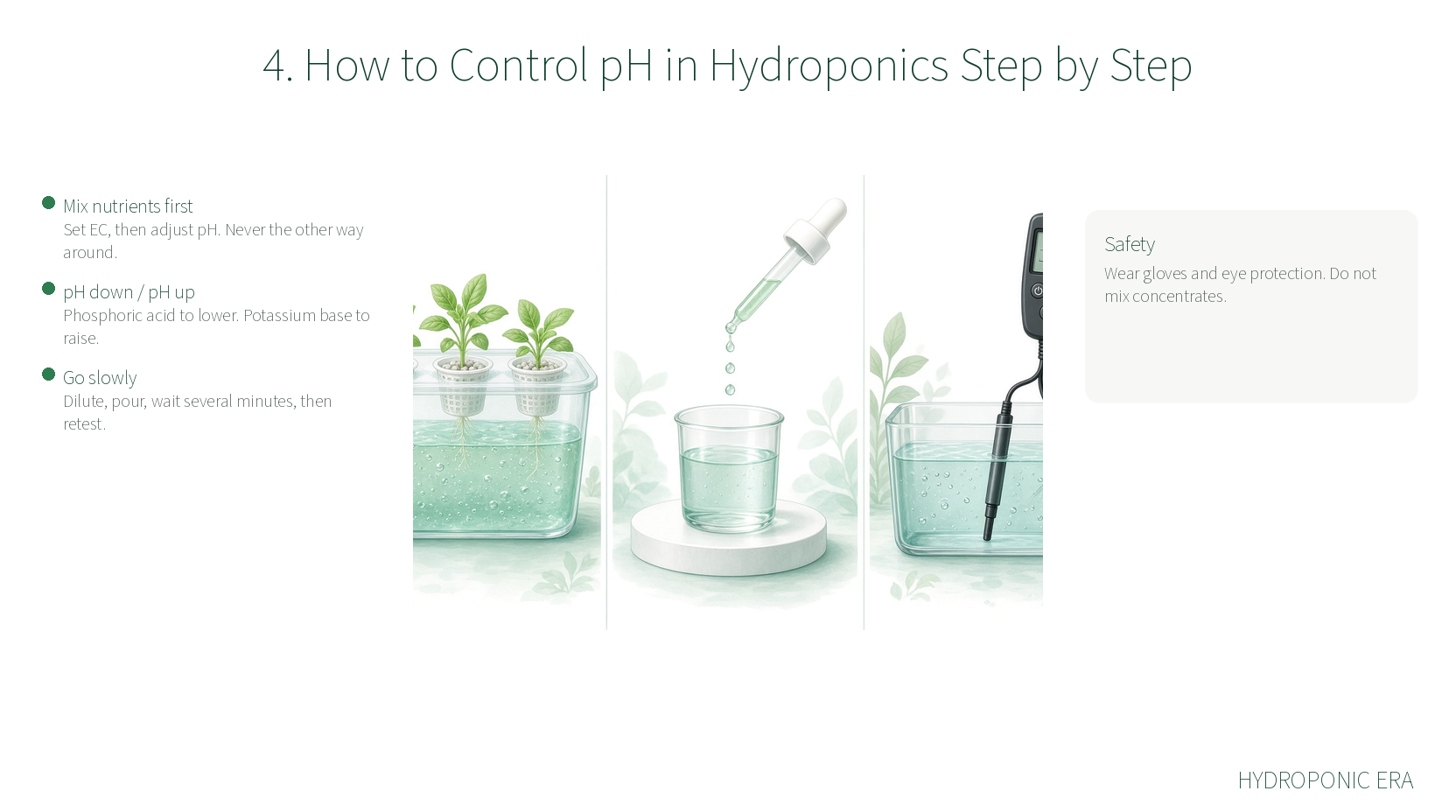
The order matters more than the brand on the bottle. This is the practical way to control pH in hydroponics after you mix a fresh tank.
- Test source water for pH, EC, and alkalinity if you can. Alkalinity is not the same as “alkaline water.” It is the water’s ability to resist acid, mostly from bicarbonates.
- Fill the reservoir and mix nutrients completely. Keep A and B concentrates separate until they are diluted, or calcium can precipitate.
- Set electrical conductivity (EC) first. pH second.
- Circulate, then measure pH with a calibrated meter.
- If pH is high, add pH down (usually food-grade phosphoric acid). If it is low, add pH up (typically potassium hydroxide or potassium carbonate).
- Add a little at a time. Dilute the dose in a cup of reservoir water, pour it in, wait several minutes, and test again.
- Stop when you are inside the target band. Do not chase 5.80 on the nose.
Never mix concentrated pH up and pH down together. Wear gloves and eye protection. These products are corrosive.
Vinegar and citric acid will drop pH, but the reading often rebounds because plants and microbes consume those organic acids. For a stable recirculating system, phosphoric acid is the more reliable pH down.
Baking soda can raise pH in a pinch, but it adds sodium. Missouri Extension advises against sodium bases for food crops. Use a potassium-based pH up instead.
Why Does Hydroponic pH Keep Drifting?

If you add pH down every morning and the reading is high again by night, the water is usually the cause. High alkalinity (Oklahoma State flags anything above 75 ppm) pushes pH up. Missouri Extension’s suitable window is roughly 40 to 160 ppm as calcium carbonate.
Reverse-osmosis water does the opposite. It has almost no buffer, so a few drops swing pH hard. Mix nutrients first, then fine-tune.
Plant uptake also moves the needle. Nitrate-heavy feeds tend to raise solution pH, which is why beginners use pH down more than pH up. Cover the reservoir. Algae and a dirty tank make readings jump.
This is also why a full solution change matters. Oklahoma State recommends replacing recirculating solution about every two weeks so salts do not drift out of balance. For the schedule, see how often to change hydroponic water.
What Happens When Hydroponic pH Is Too High or Too Low?

High pH is the usual beginner problem. Iron, manganese, zinc, copper, and boron become less available. New leaves turn pale between the veins while older leaves still look fine.
That is classic iron lockout. More fertilizer does not fix it. The nutrients are already there. University of Georgia describes this high-pH micronutrient pattern in greenhouse crops.
Low pH can make micronutrients too available and raise toxicity risk. Calcium, magnesium, and molybdenum problems show up more often when the root zone is too acidic.
If leaves are yellow and you have not measured yet, measure before you change the recipe. Our guide to hydroponic leaves turning yellow covers the other common causes.
A Simple Routine to Control pH in Hydroponics

When you mix a new reservoir: water in first, nutrients to your EC target, circulate, then bring pH into 5.5 to 6.5 or to the crop row above.
Daily (DWC, NFT, and other recirculating systems): check EC, then pH, at the same time each day. Top up as needed. Adjust only if you are outside the band. Write the numbers down.
Weekly: calibrate the meter at 4.0 and 7.0. Check roots and keep light off the solution.
About every two weeks: replace recirculating solution instead of endlessly correcting an old tank.
Start small. Change one variable at a time. If pH, EC, and the nutrient brand all change on the same afternoon, you will not know what helped.
Aquaponics is different. Nitrifying bacteria prefer a higher compromise pH, often around 6.4 to 7.4. Do not use a 5.5 mineral-hydro target in a fish tank.
Common Mistakes When You Control pH in Hydroponics

- Adjusting pH before nutrients are mixed
- Adding big doses and swinging past the target
- Trusting an uncalibrated meter
- Watching pH and ignoring alkalinity
- Using test strips in dyed nutrient solution
- Treating lockout with more fertilizer
- Using kitchen acids or baking soda as a long-term plan
Frequently Asked Questions
What is the best pH for hydroponic lettuce?
Oklahoma State lists 6.0 to 7.0. Many home growers keep lettuce closer to 5.8 to 6.2. Stay consistent and watch the leaves.
Should I adjust pH before or after adding nutrients?
After. Nutrients change pH. Mix, wait, then adjust. That is the core of how to control pH in hydroponics without wasting bottles.
Do I need both pH up and pH down?
Yes. Most tap water and nitrate feeds drift up, so you will use pH down more. Keep pH up on hand for overshoots and very soft water.
Can I grow hydroponic plants at pH 7?
Some crops tolerate it. Iron and other micronutrients become harder to take up above 6.5. Mildly acidic is the safer beginner default.
What is the ideal pH range for hydroponics?
Most hydroponic crops grow best with nutrient solution pH between 5.5 and 6.5. Leafy greens often prefer the lower end of that range; fruiting crops may sit slightly higher. Always confirm with crop-specific guidance and measure after mixing nutrients.
How often should I check hydroponic pH?
Check pH at least daily when you are learning, and every 1–2 days once the system is stable. Check after adding nutrients or topping up water, because those changes often shift pH.
Why do my hydroponic plants look hungry even when I feed them?
If pH is outside the plant’s uptake window, roots cannot absorb nutrients efficiently even when EC looks fine. Correct pH first, then reassess nutrient strength and symptoms.
Related reading
- Aeroponics for Beginners
- Hydroponic Tower Garden
- Best Grow Lights for Hydroponics
- Why Hydroponic Roots Turn Brown
- How to Control pH in Hydroponics for Beginners
Final Thoughts
You do not need a perfect reading. You need a stable band. For most hydroponic crops, that band is 5.5 to 6.5.
Mix nutrients, set EC, then nudge pH with small doses. Check daily in active systems, calibrate weekly, and replace old solution instead of fighting it.
Measure first. Adjust second. Change one thing at a time. That is how to control pH in hydroponics without turning the reservoir into a science experiment.
Internal Related Articles For Hydroponicera
- How Often to Change Hydroponic Water? Proven Complete Guide
- Why Are Hydroponic Leaves Turning Yellow? 7 Common Problems and Easy Solutions
- Hydroponic Garden: Complete Beginner’s Guide to Growing Plants Without Soil
- Indoor Hydroponic Garden: Complete Beginner’s Guide to Growing Plants Indoors
- How to Grow Lettuce Hydroponically: Proven Secrets to a Successful Harvest
Sources and Further Reading
- University of Missouri Extension — Hydroponic Nutrient Solutions
- Oklahoma State University — Electrical Conductivity and pH Guide for Hydroponics
- Penn State Extension — Hydroponics Systems and Principles of Plant Nutrition
- University of Georgia — Essential pH Management in Greenhouse Crops
pH in Hydroponics: A Quick Troubleshooting Checklist
When a reading does not make sense, slow down and check the process before adding more chemicals. The safest way to control pH in hydroponics is to confirm the measurement, make one small change, and measure again after the solution has mixed.
Check the meter before you adjust
Rinse the probe with clean water, gently shake off droplets, and follow the meter maker’s calibration instructions. A dirty or poorly calibrated probe can send you in the wrong direction. If you use liquid or strip tests, compare the color in the recommended light and use a fresh sample from the reservoir. Consistent technique is a key part of pH in hydroponics because a change of a few tenths can affect nutrient availability.
Separate measurement problems from reservoir problems
Take a second reading from a well-mixed sample rather than dosing immediately. Check that the nutrient solution is at a stable temperature, and note the time, pH, and EC or TDS in a simple log. This record helps you see whether pH in hydroponics is drifting gradually or changing right after feeding, topping up, or cleaning.
Make small corrections safely
Add pH-up or pH-down according to the product label, dilute it if the instructions call for dilution, and add it where the reservoir can circulate it. Never mix concentrated pH-up and pH-down together. Wait for thorough circulation, then retest. Beginners often get better results when they control pH in hydroponics with several small adjustments instead of one large dose.
Use the pattern to find the cause
A steady rise can point to normal nutrient uptake, source-water alkalinity, evaporation, or a solution that needs refreshing. A sharp swing after dosing may indicate poor circulation or an overcorrection. A falling reading can follow acidic inputs or changing root activity. The exact cause depends on the crop and system, so use your log and the manufacturer’s guidance rather than guessing. Good pH in hydroponics management is repeatable, measured, and gentle on the roots.
If the reservoir keeps drifting despite accurate measurements, review the water source, nutrient mixing order, reservoir size, and cleaning routine. Check the crop’s recommended range instead of chasing a single perfect number. With a calibrated meter and a written routine, you can control pH in hydroponics confidently while keeping the rest of the system stable.
81 thoughts on “How to Control pH in Hydroponics for Beginners”